Visualisation of Thermal Energy Data
Last Updated: December 2025 | Click images to enlarge
Thermal Energy is the portion of energy within an energy system that is associated with heat generation, distribution, storage, or consumption.
It includes both low- and high-temperature heat used for:

Residential & commercial
heating /cooling

District heating /cooling

Industrial processes

Power generation

Fossil fuels

Biomass

Electricity

Solar thermal

Geothermal
1.1. Domestic Solar Heater Technologies
The two most common Solar Water Heater (SWH) technologies consist of the Flat Plate Collector (FPC) and the Evacuated Tube Collector (ETC). An FPC consists of winding copper pipes inside a frame, usually with a glass covering, that heat the water directly running through the pipes. An ETC uses parallel glass tubes with a vacuum for insulation and a secondary refrigerant-like liquid to absorb and transfer the heat to the water.
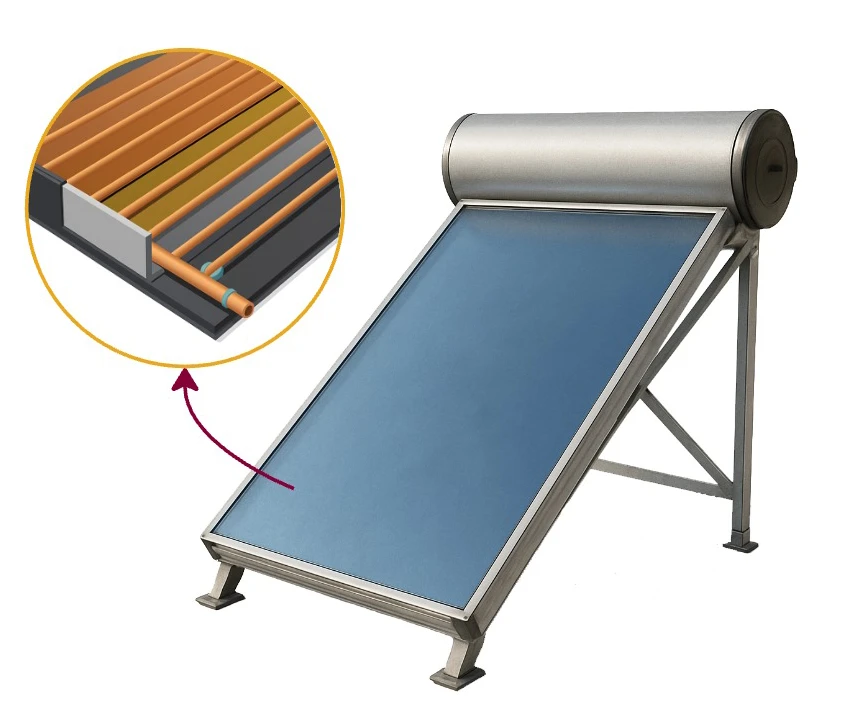
Flat Plate Collector (FPC)
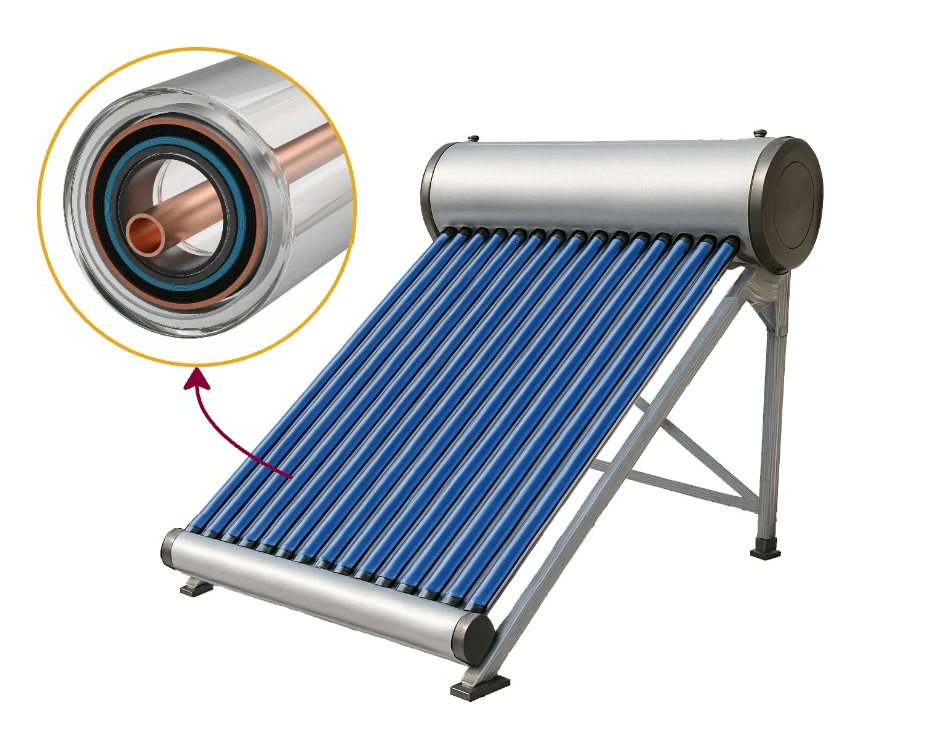
Evacuated Tube Collector (EPC)
1.2. Solar Thermal Technologies
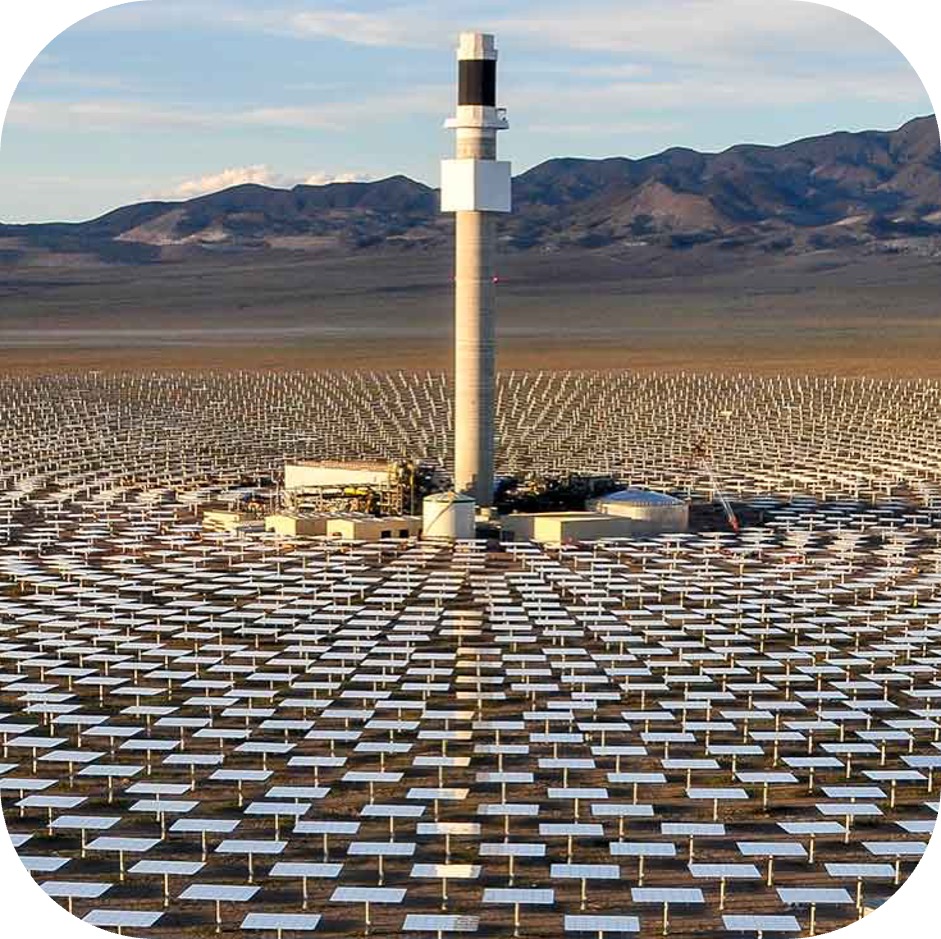
Concentrated Thermal Power
(CSP)
CSP systems use mirrors or lenses to focus sunlight onto a central receiver, heating a fluid to high temperatures. This thermal energy is then used to produce steam that drives a turbine connected to a generator, producing electricity. CSP systems often include thermal energy storage, allowing power generation even when the sun isn't shining.
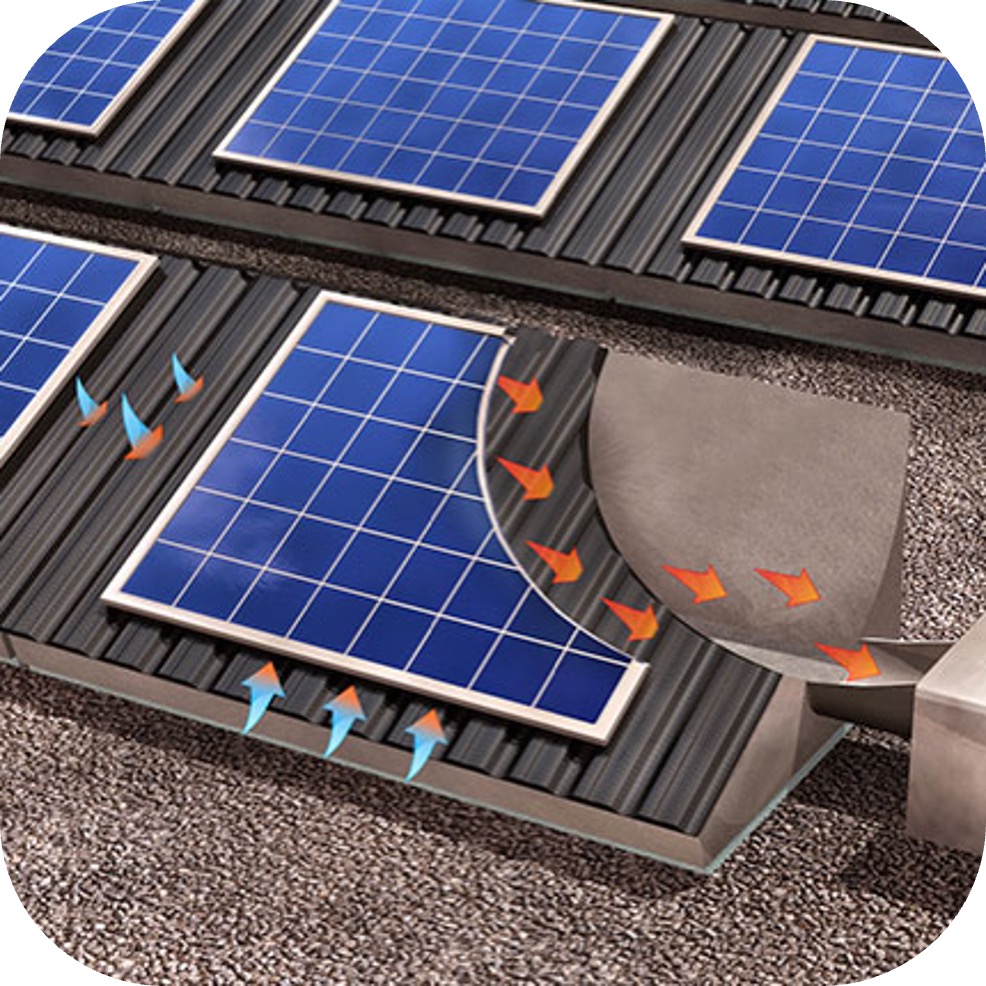
Photovoltaic Thermal
(PVT)
PVT systems combine solar PV panels with a thermal collector to generate both electricity and heat from the same surface area. The PV panel converts sunlight into electricity, while a fluid behind the panel captures waste heat, improving overall energy efficiency. PVT systems are ideal for applications needing both power and thermal energy.
1.3. Sustainability Technologies
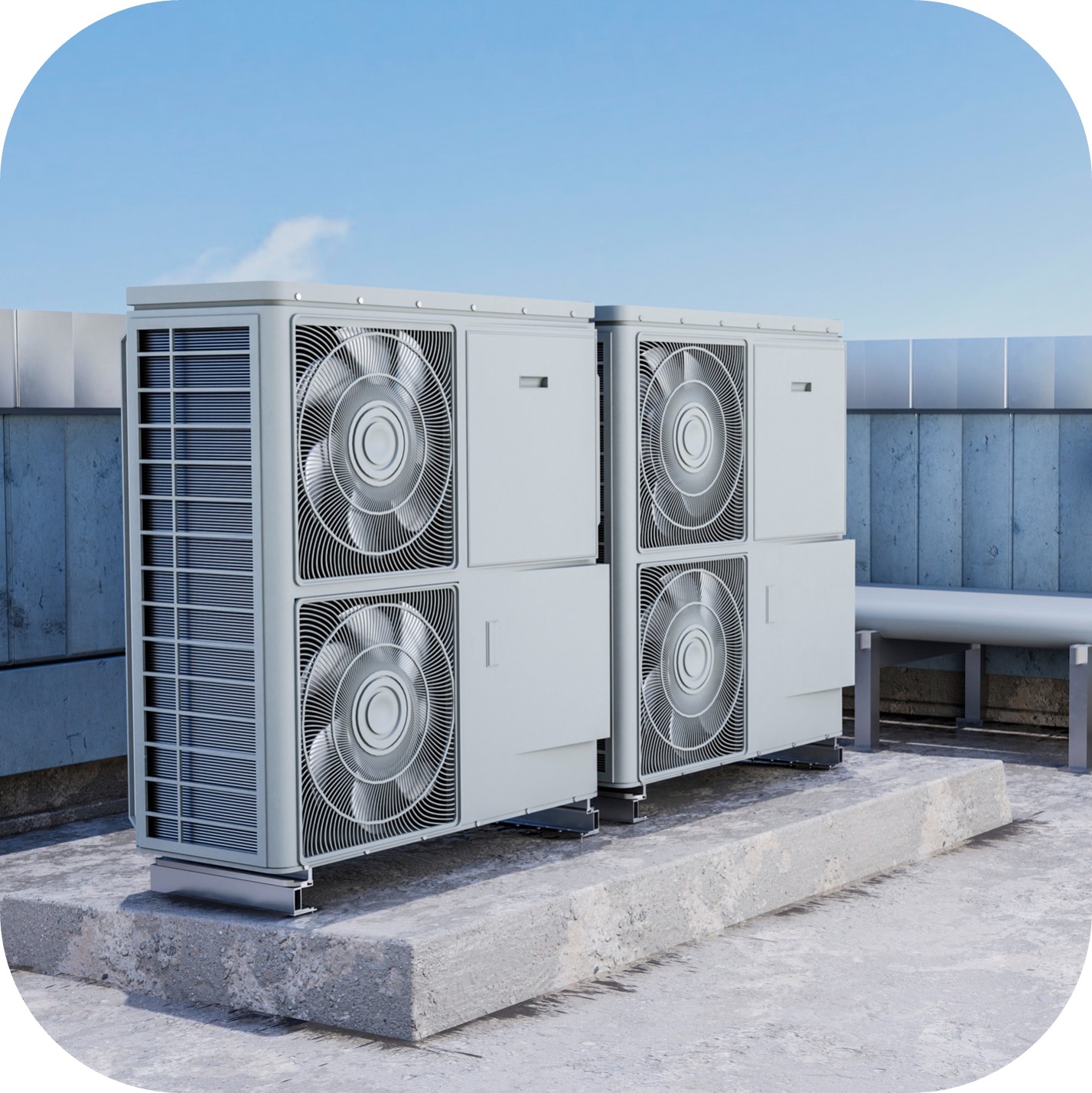
Heat Pump (HP)
A HP is a highly efficient device that transfers heat from one place to another using a refrigeration cycle. It can extract heat from the air, ground, or water and move it indoors for heating, or reverse the cycle for cooling. HPs use electricity but deliver more thermal energy than they consume, making them an energy-efficient solution for space and water heating.
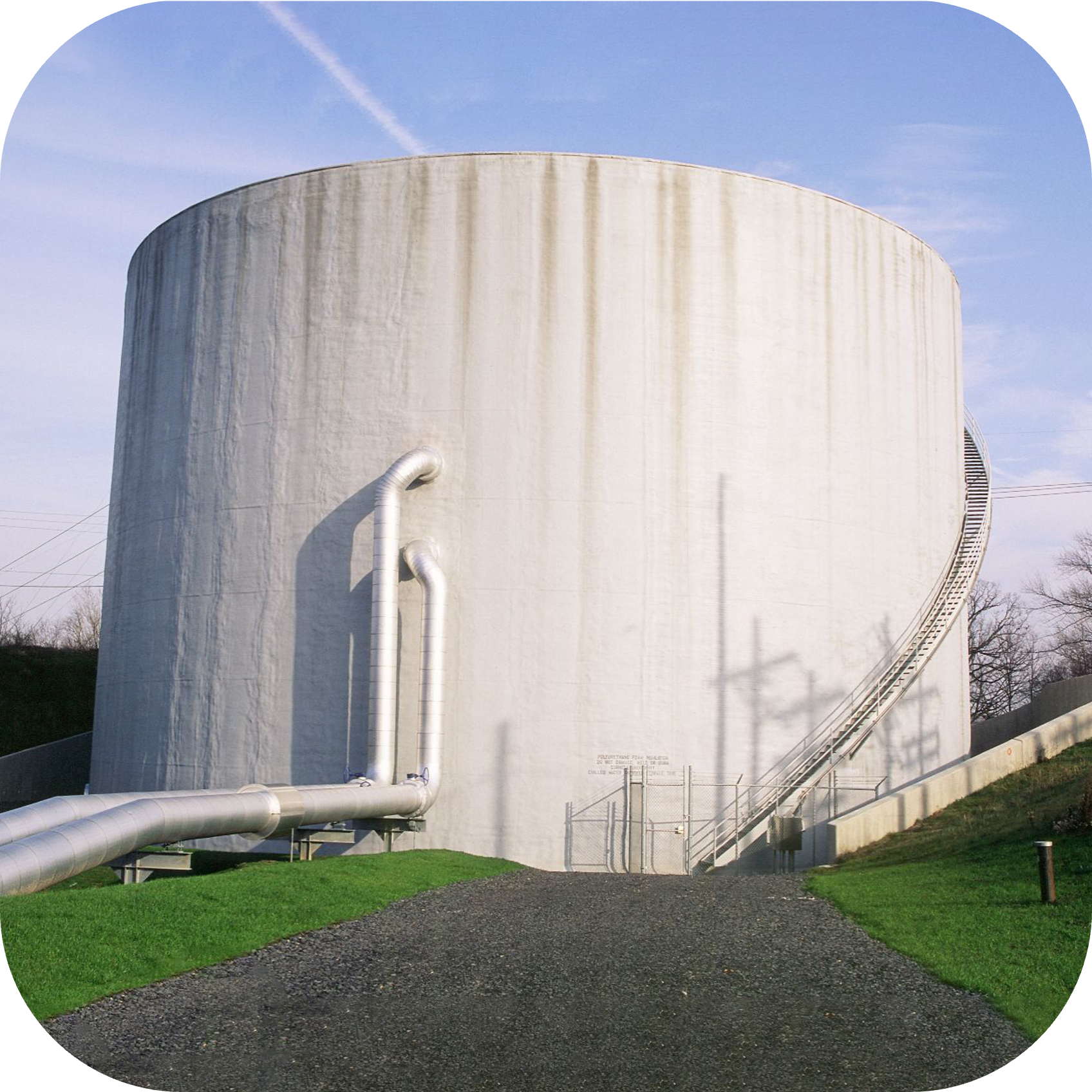
Thermal Energy Starage (TES)
TES systems store excess heat for later use, improving energy efficiency and balancing supply and demand. They typically use materials like water, molten salts, or phase change materials to retain thermal energy. Heat can be collected from solar systems, waste heat, or electricity-driven HPs, and release it when needed for space heating, cooling, or industrial processes.
1.4. Traditional Technologies

Coal and oil burners generate heat by combusting fossil fuels, commonly used in older industrial and residential systems. Biomass burners use organic materials like wood pellets or agricultural waste as a renewable alternative. Electric boilers and geysers heat water using electrical resistance, offering cleaner operation but often at higher energy costs if not paired with renewable electricity.
1.5. Important Definitions

Solar fraction (SF) is a measure of how much of a system's total heating or energy demand is covered by solar energy compared to electrical energy. It is usually expressed as a percentage and indicates the contribution of solar power compared to other energy sources.

Coefficient of Performance (COP) is a measure of a heating or cooling system's efficiency. It is the ratio of useful thermal energy output to the electrical energy input. Heat Pumps have a COP greater than 1, meaning they provide more thermal energy than the electrical energy input.

Thermosyphon systems rely on natural convection: hot water rises from the collector into a tank placed above it, requiring no pump. These are systems are easily identified as the tank sits above the collectors on the roof. Pumped systems, by contrast, use an electric pump to circulate water between the collector and a tank, allowing more flexible placement of components. The tank may now sit anywhere below the collectors.
2. World Trends in Thermal Energy
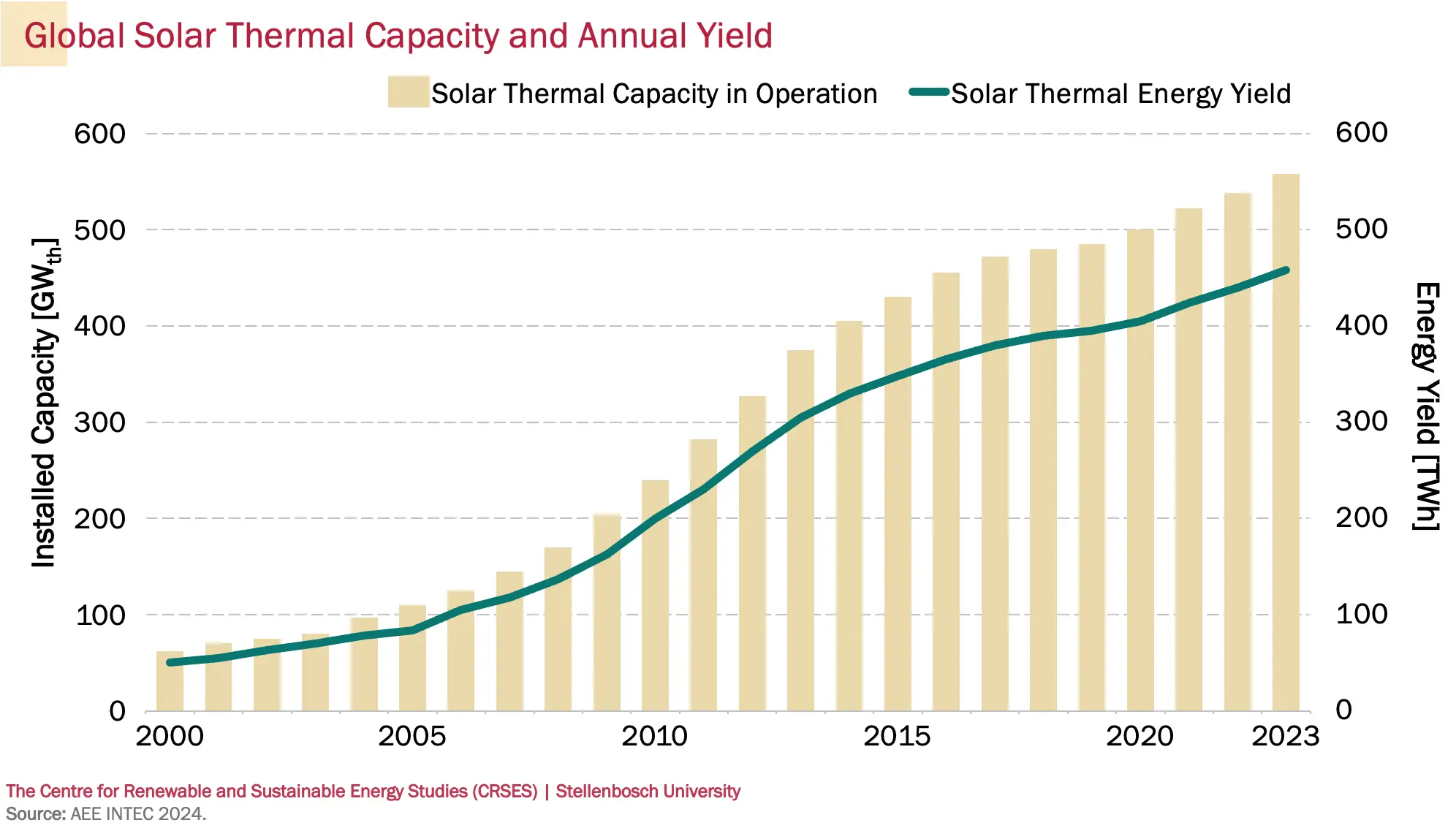
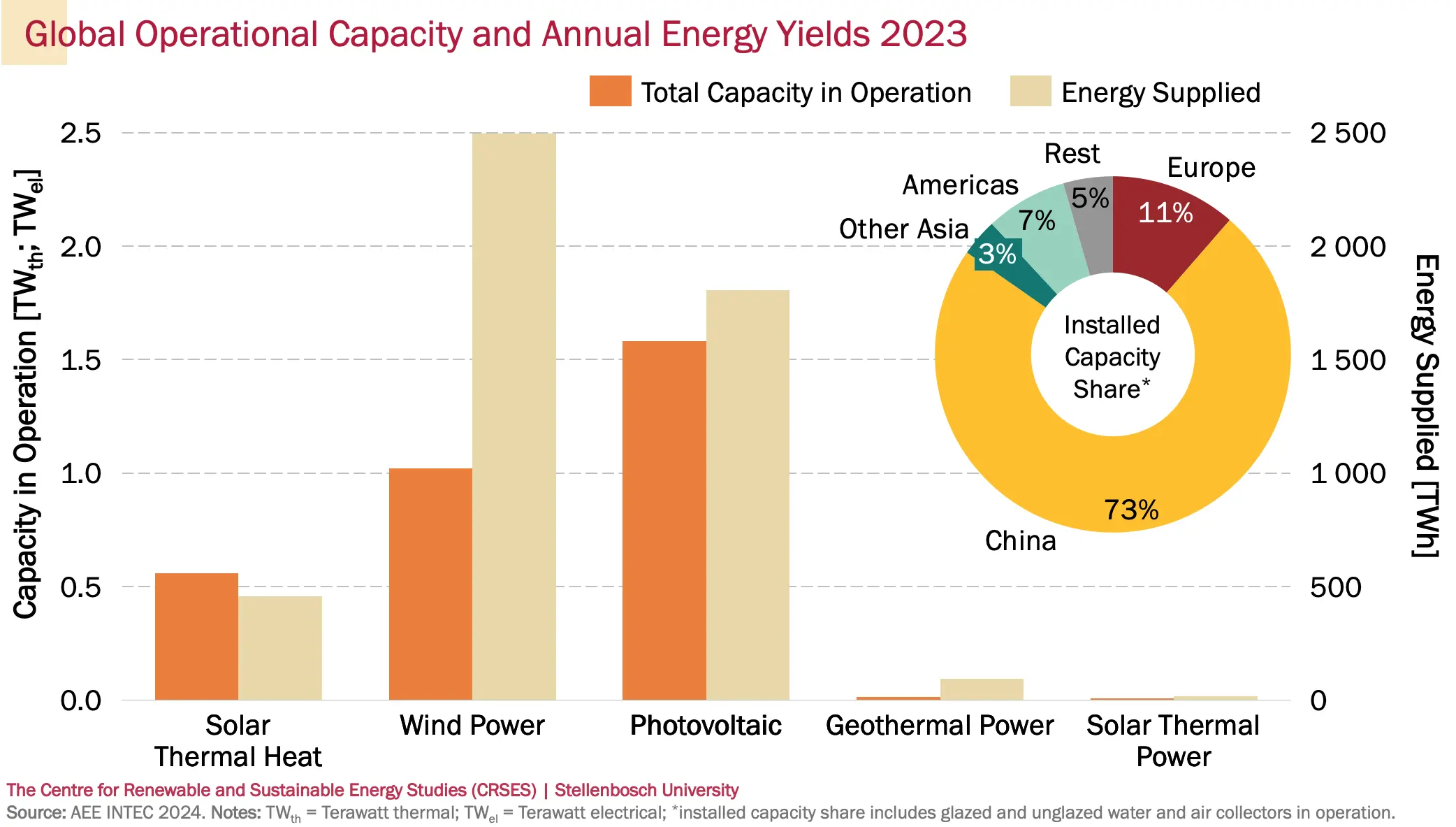
Globally, solar-thermal collector capacity has grown steadily, with large contributions from domestic hot-water systems in Asia, Europe, and Latin America. Energy yield in TWh tracks this rising installed base. However, growth slowed after 2013 as earlier subsidy programmes ended in China and Denmark.
The global thermal data is sourced from Solar Heat Worldwide by the International Energy Agency (IEA) and a more comprehensive view of their data can be found on their website.
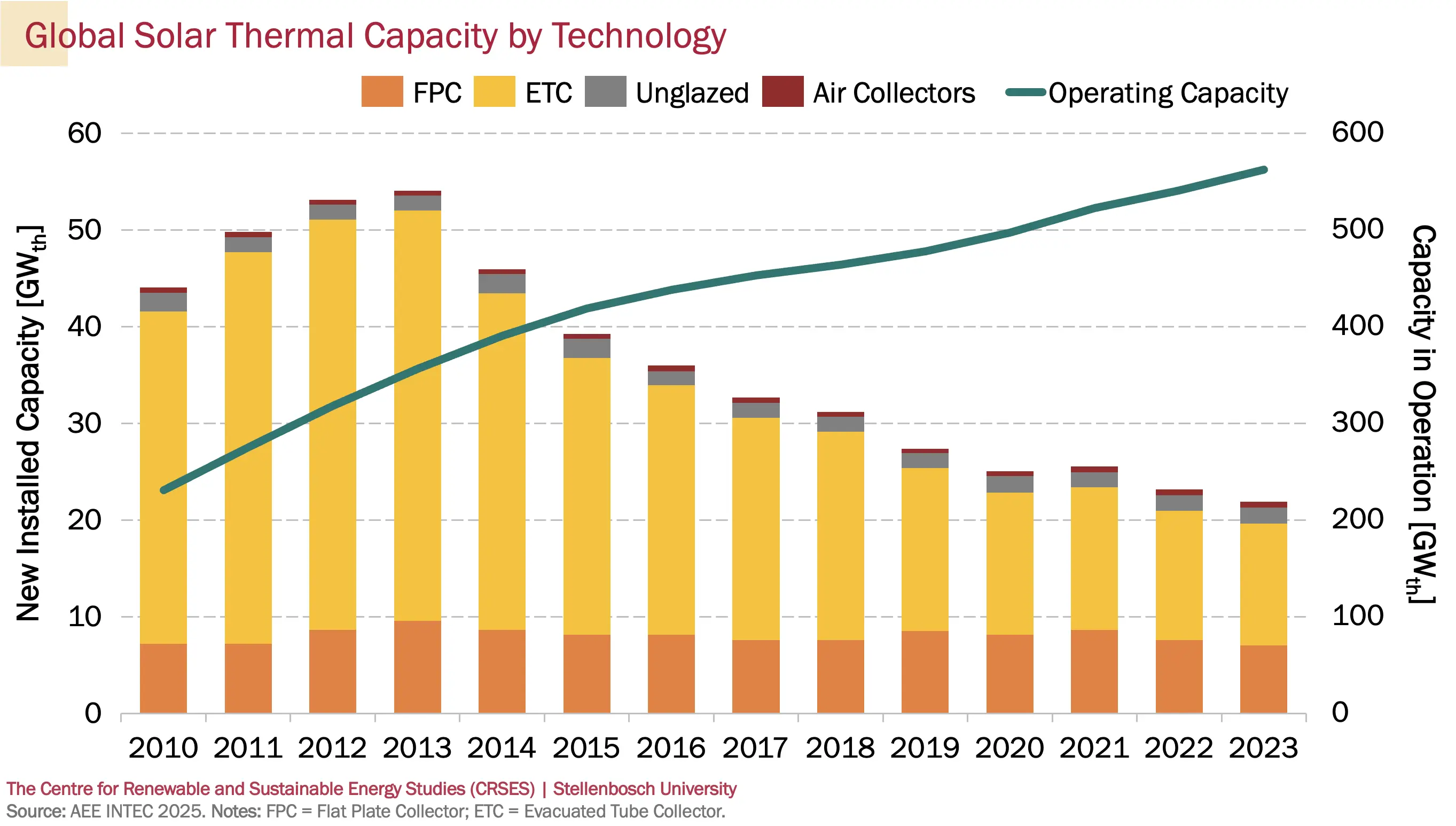
This next diagram contrasts total operational solar-thermal capacity with newly installed capacity each year. Flat-plate collectors (FPCs) and evacuated tubes (ETCs) dominate. Although many mature markets slowed post-2013, new regions — MENA, Latin America — are now expanding.
Here, global thermal capacity and actual energy delivered is compared to other renewable energy sources globally. Solar thermal power generation is out shadowed by solar thermal heat, and power from wind and photovoltaics (PV). The distribution of solar thermal collector area, for heat or power, is shown by region.
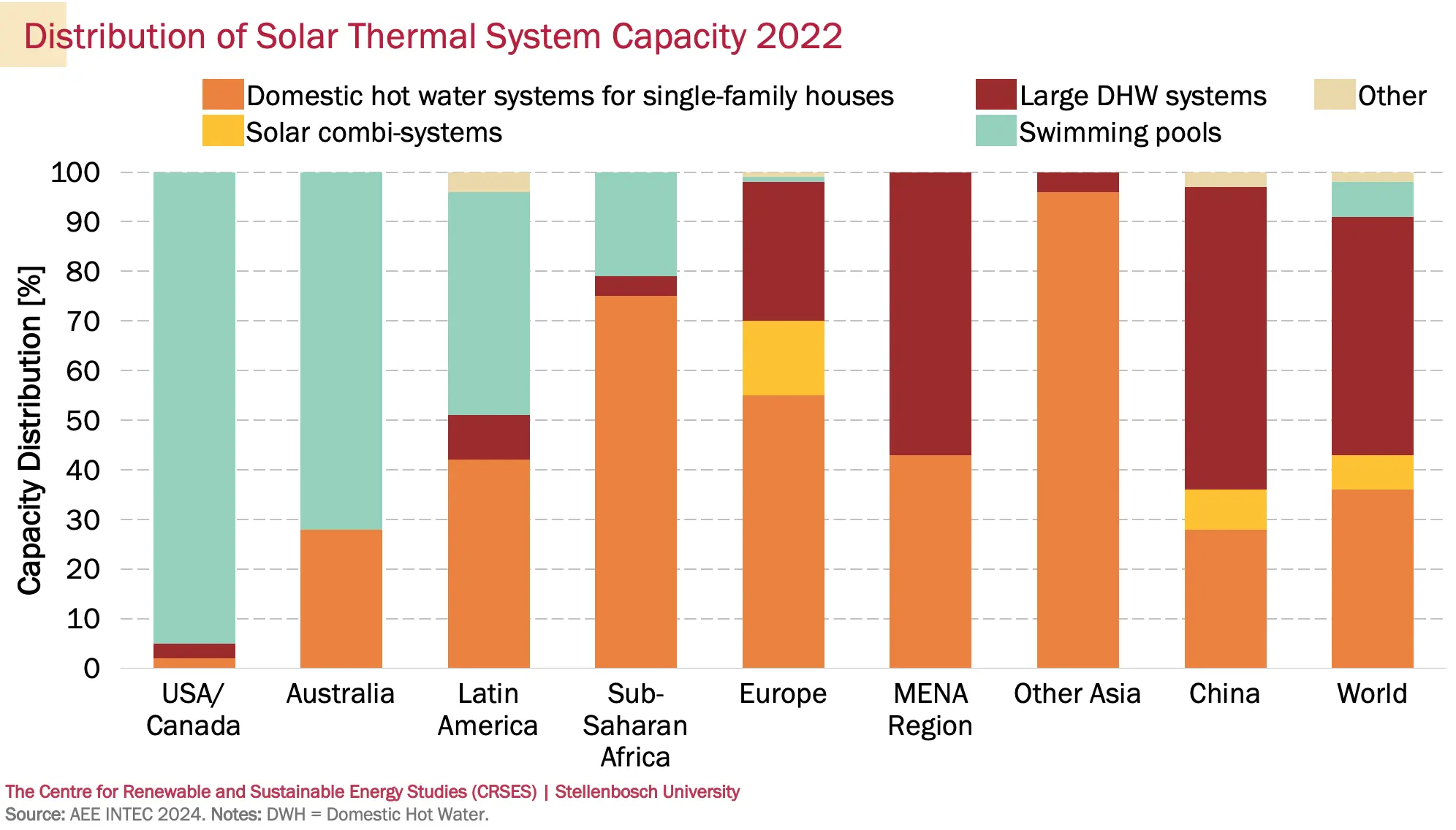
This data shows the global distribution of total collector area across different applications, including domestic hot water (DHW), large DHW systems, swimming pools, and solar combi-systems. Domestic water heating remains the dominant use in most regions, but the use of larger DHW systems is growing.
The map below shows the capacity density of installed solar thermal capacity per 1000 inhabitants. Highlighted countries with high market penetration density include China, Turkey, Denmark, Germany, Austria, and Greece.
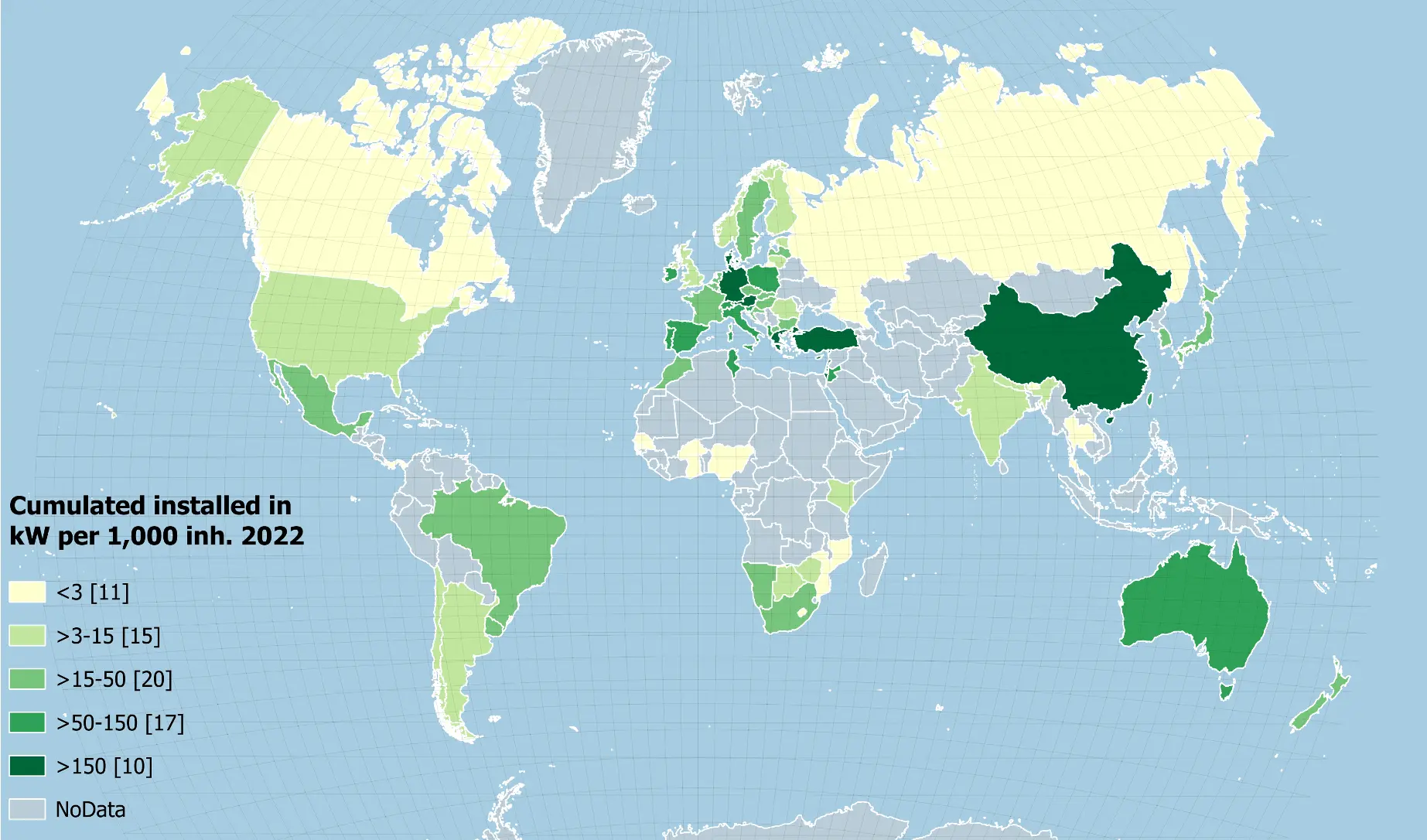
Image source: AEE INTEC 2024.
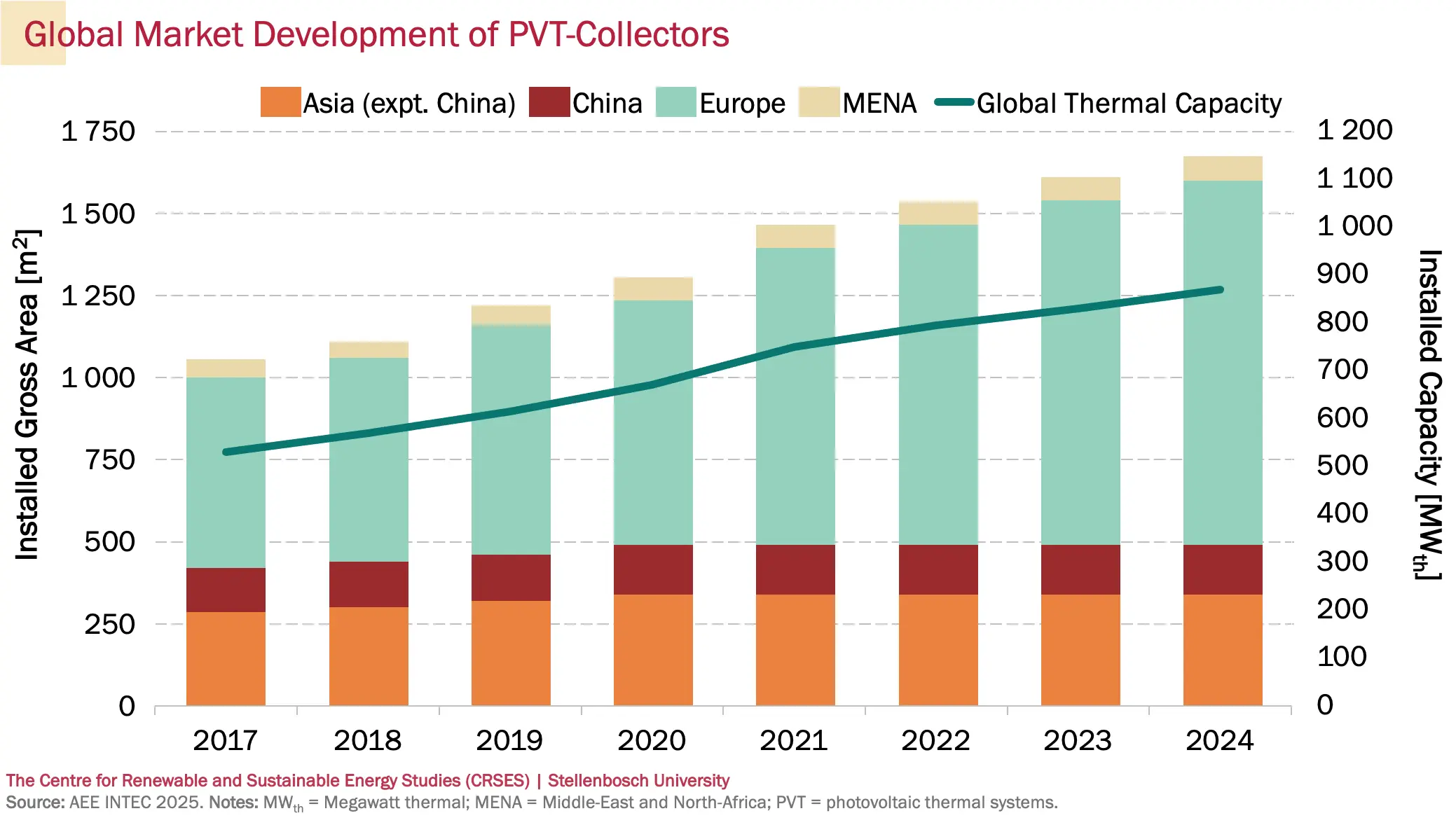
Photovoltaic Thermal Systems (PVT) combine solar thermal heat and PV electricity production within the same collector. This can boost total energy yield per installed collector area. This is especially promising when the available installation area is limited, such as the rooftop of high-rise buildings. Adoption remains modest compared to traditional PV and thermal systems, partly due to higher costs and varying market support. Europe has seen the biggest growth of PVT systems (65%), followed by Asia (28%), MENA (4%), and the rest of the world (3%).
3. Thermal Energy in South Africa
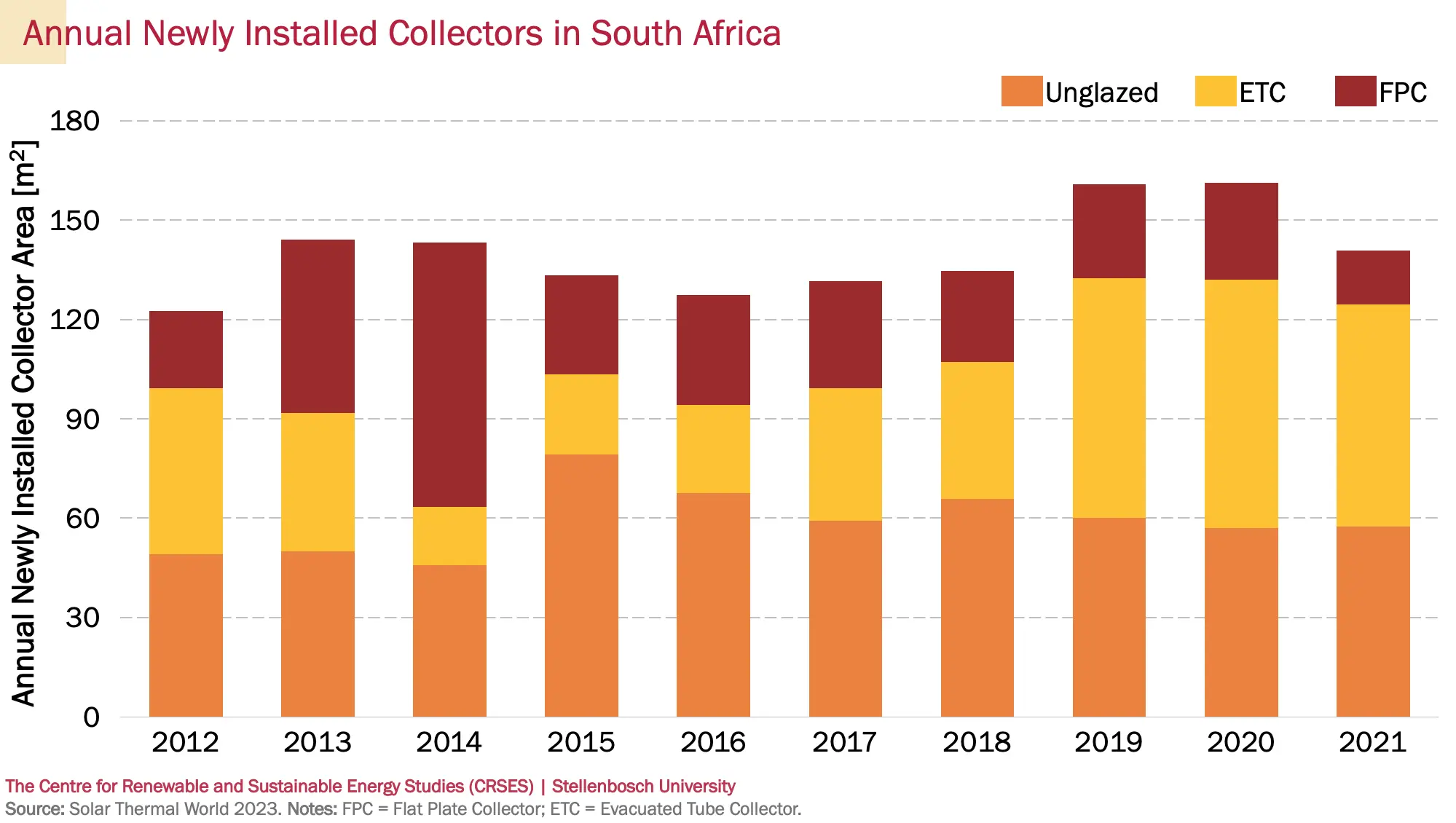
South Africa's solar-thermal market grew rapidly during the period when Eskom subsidies were available (until around 2015). After subsidies ended, installations slowed but remained supported by building regulations requiring solar or heat-pump water heating in new buildings.
4. Industry (SHIP)
The SHIP database (Solar Heat for Industrial Processes) is a public online platform that maps and documents industrial solar-thermal installations worldwide. Managed by AEE INTEC under the IEA Solar Heating & Cooling Programme, it provides detailed information on each project, including its location, collector type, thermal capacity, industrial sector, and operating temperature range. The database helps researchers, engineers, and developers understand global market trends, compare technologies, and identify suitable reference cases for new industrial heat projects. Because industrial heat represents a major share of global energy demand, the SHIP database serves as an important resource for tracking how solar thermal is being adopted across different sectors and regions.
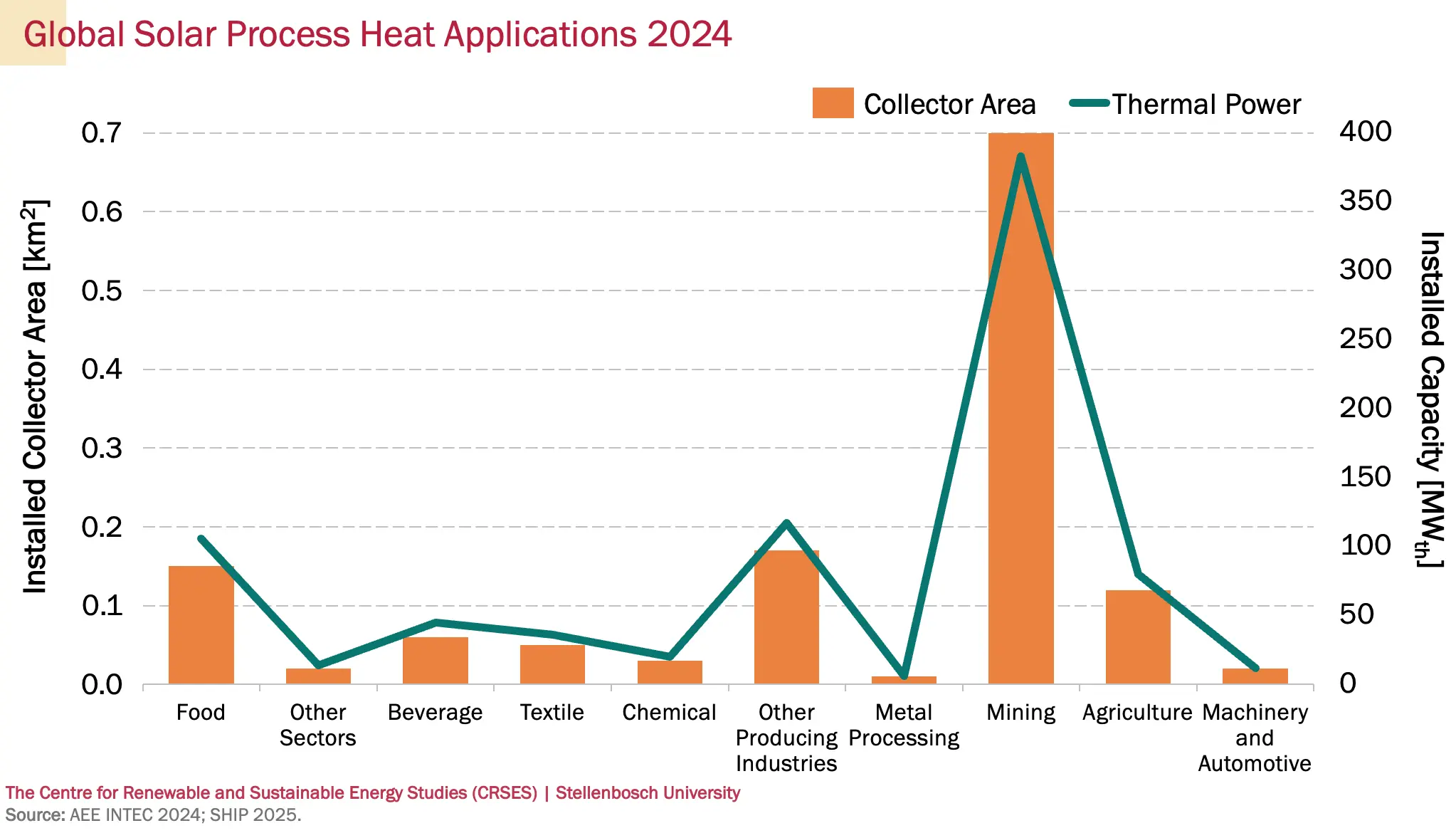
Below are some visual insights gained from the SHIP database, including the global collector area and thermal power per industry category, which is largely concentrated in the mining sector.
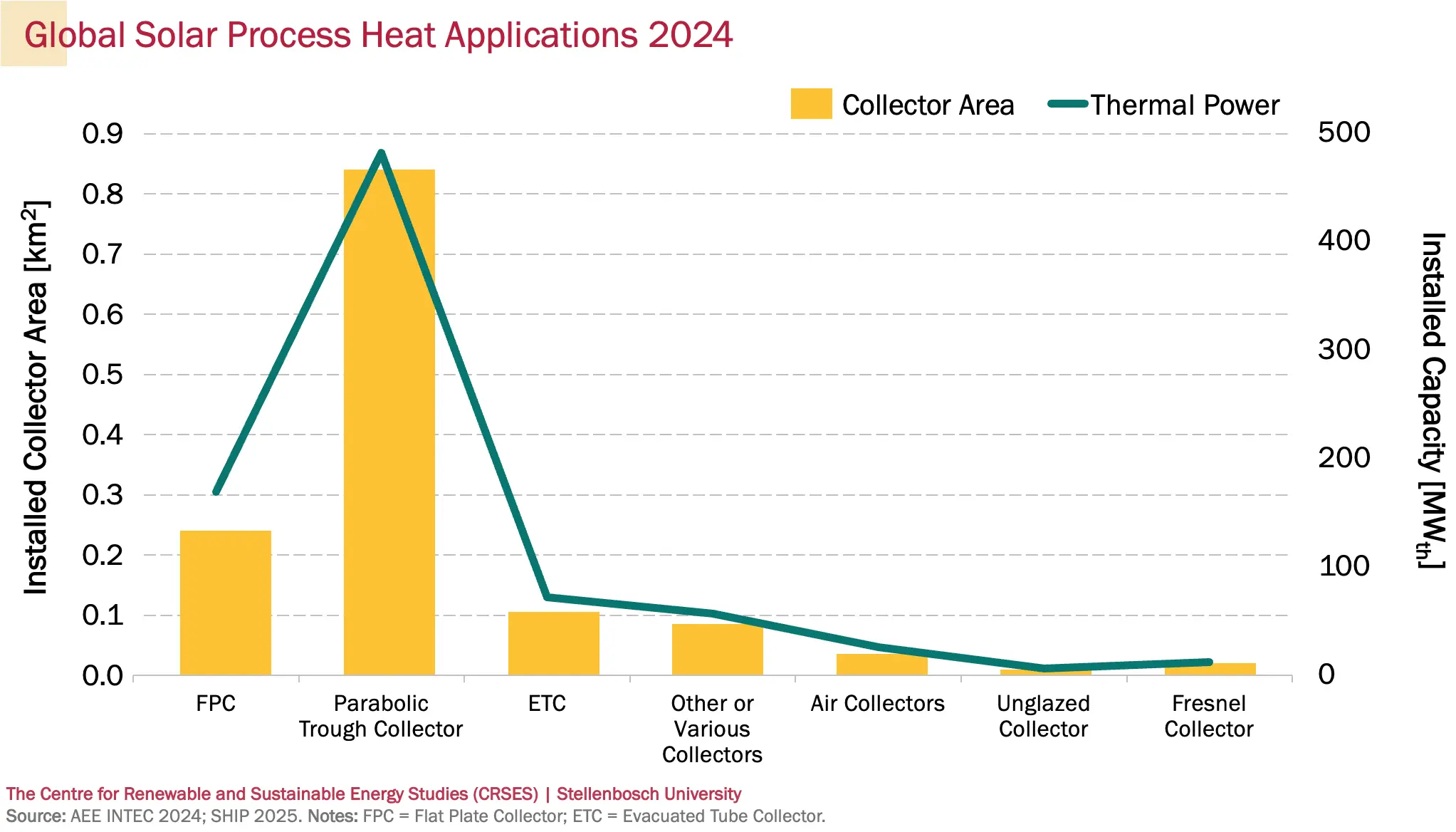
The diagram below provides detail into which solar thermal technologies are being used in industry across all sectors. This is dominated by parabolic trough collectors for larger scale systems compared to domestic applications.
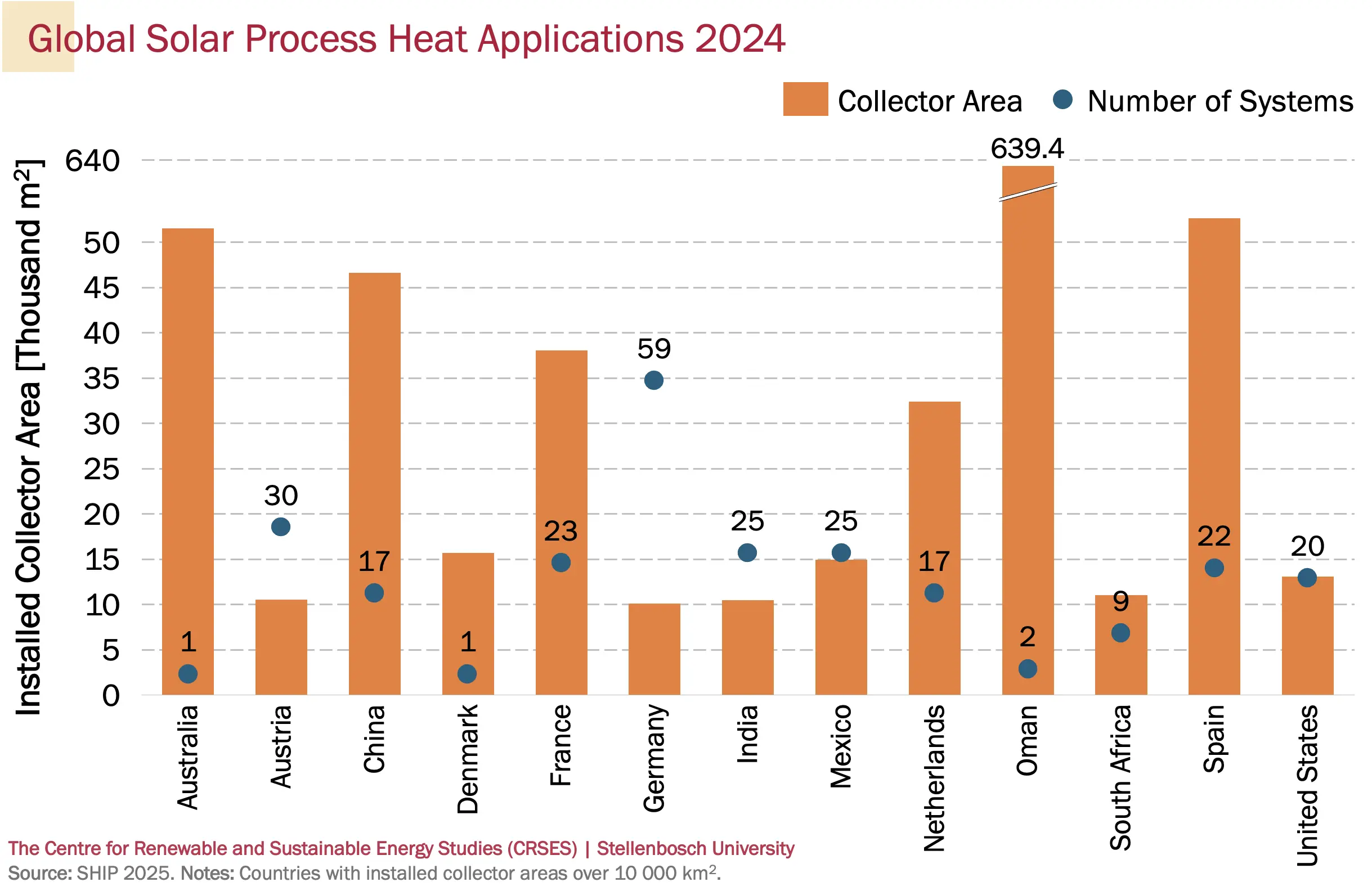
The industry data is then categorised by country in terms of installed collector area and total number of systems. Interestingly, Oman has the largest collector area by far, installed in only 2 systems.
Finally, we look at the thermal power each of these countries has installed in industry applications.

References
AEE INTEC 2025: Monika Spörk-Dür (2025). Solar Heat Worldwide, 2025 Edition. AEE Institute for Sustainable Technologies, SHC.
https://www.iea-shc.org/solar-heat-worldwide
AEE INTEC 2024: Werner Weiss, Monika Spörk-Dür (2024). Solar Heat Worldwide, 2024 Edition. AEE Institute for Sustainable Technologies, SHC.
https://www.iea-shc.org/solar-heat-worldwide
SHIP 2025: AEE Institute for Sustainable Technologies (2025). Solar Heat for Industrial Processes (SHIP).
https://energieatlas.aee-intec.at/index.php/view/map?repository=ship&project=ship_edit
Solar Thermal World 2025: Bärbel Epp (2025). Spotlight on the South African solar thermal market. International Copper Association Europe (ICA Europe).
https://solarthermalworld.org/news/spotlight-on-the-south-african-solar-thermal-market/
Icons and Stock Images:
- Solar House by Maya Nurhayati
https://thenounproject.com/browse/icons/term/solar-house (CC BY 3.0) - Industry by Sofiah
https://thenounproject.com/browse/icons/term/industry (CC BY 3.0) - Power Plant by Vectors Point
https://thenounproject.com/browse/icons/term/power-plant (CC BY 3.0) - urban heat by krisna arga muria
https://thenounproject.com/browse/icons/term/urban-heat (CC BY 3.0) - fossil fuels by krisna arga muria
https://thenounproject.com/browse/icons/term/fossil-fuels/ (CC BY 3.0) - biomass by Hanbai
https://thenounproject.com/browse/icons/term/biomass/ (CC BY 3.0) - Electricity by metami septiana
https://thenounproject.com/browse/icons/term/electricity (CC BY 3.0) - solar thermal by Alhaliza Risma Elvariani
https://thenounproject.com/browse/icons/term/solar-thermal (CC BY 3.0) - geothermal by Asiah
https://thenounproject.com/browse/icons/term/geothermal (CC BY 3.0) - Thermal energy by Creative Studio
https://thenounproject.com/browse/icons/term/thermal-energy/ (CC BY 3.0) - Solar Roof by sopiah
https://thenounproject.com/browse/icons/term/solar-roof/ (CC BY 3.0) - Efficiency by Garoks
https://thenounproject.com/browse/icons/term/efficiency/ (CC BY 3.0) - Water Pump by Cahya Kurniawan https://thenounproject.com/browse/icons/term/water-pump/ (CC BY 3.0)
- Image: https://www.nrel.gov/csp/
- Image: https://www.solarwall.com/technology/pv-t/
- Image: https://fcs.cornell.edu/departments/energy-sustainability/utilities-production-distribution/district-cooling/cooling-production/thermal-storage-tank
Copyright: Visualisation of South African Energy Data © 2024 by The Centre for Renewable and Sustainable Energy Studies (Stellenbosch University) is licensed under CC BY-SA 4.0. Adapters must indicate any modifications made to the original work. Stellenbosch University is disclaimed as the copyright owner and bears no responsibility for the use of derivatives.